

Views: 0 Author: Site Editor Publish Time: 2025-12-15 Origin: Site
High-efficiency filtration is no longer a niche upgrade — it is central to modern vehicle performance, emissions control, and total cost of ownership. At the core of this evolution sits Air Filter Paper: the engineered medium that determines how well an engine breathes, how cleanly fuel is burned, and how long internal components last. This article explains the technical and practical advantages of high-efficiency filters for automobiles, compares common filtration media, presents data-oriented comparisons and decision-making guides, and answers frequently asked questions. It is written to help fleet managers, parts engineers, aftermarket sellers, and informed car owners pick the right filtration solution.
Automotive filtration is a systems problem. Clean intake air, clean fuel, and clean oil work together to keep combustion efficient, emissions low, and wear minimal. If any single filtration element underperforms, the whole system degrades — for example, dirty intake air increases soot, which accelerates oil contamination and shortens oil filter life. High-efficiency filters reduce the downstream load on all components, saving money and downtime.
Key points:
Engines are designed to operate with predictable airflow and clean media; filtration that changes airflow or allows contaminants through reduces the engine’s operating window.
Modern engines (turbocharged, direct injection, high compression) are more sensitive to particulate contamination than older engines.
Regulations and consumer expectations push toward both lower emissions and longer service intervals — filtration must support both.
A good filter must balance two competing metrics: particle capture efficiency and pressure drop (airflow resistance). Advances in media manufacturing allow modern filter media to capture very small particles (sub-5 microns) while keeping pressure drop low, so engines don’t work harder to draw air in. That means more complete combustion and better fuel economy.
By capturing abrasive particles before they reach pistons, rings, cylinder walls, and bearing surfaces, high-efficiency filters reduce mechanical abrasion. Over time this lowers oil contamination rates and extends engine life.
Mass airflow sensors, oxygen sensors, and particulate sensors rely on clean inlets and predictable flows. Better filtration stabilizes sensor inputs and helps the engine control unit (ECU) maintain optimal air–fuel ratios, improving emissions performance.
High-efficiency media with higher dust-holding capacity and better structural stability (pleat strength, moisture resistance) extends service intervals. For fleets and commercial users that value uptime, the incremental cost of premium filters is often outweighed by lower downtime and fewer unscheduled engine repairs.
Air Filter Paper is the engineered sheet material used in most pleated engine air filters. Its critical attributes include fiber diameter, fiber distribution, porosity gradient, basis weight, and binder/resin treatment. Optimizing these parameters allows manufacturers to tailor media for airflow, efficiency, and durability.
Important media properties and their effects:
Fiber diameter: finer fibers increase capture efficiency for small particles; coarser fibers improve dust-holding capacity.
Porosity gradient (multi-layer): coarse outer layers trap large debris; finer inner layers capture smaller particles without blocking airflow early.
Resin impregnation and stabilization: improves wet strength, collapse resistance, and high-temperature performance.
Manufacturers often combine Air Filter Paper with nanofiber coatings or surface treatments to trap ultrafine particles while keeping the pressure drop minimal.
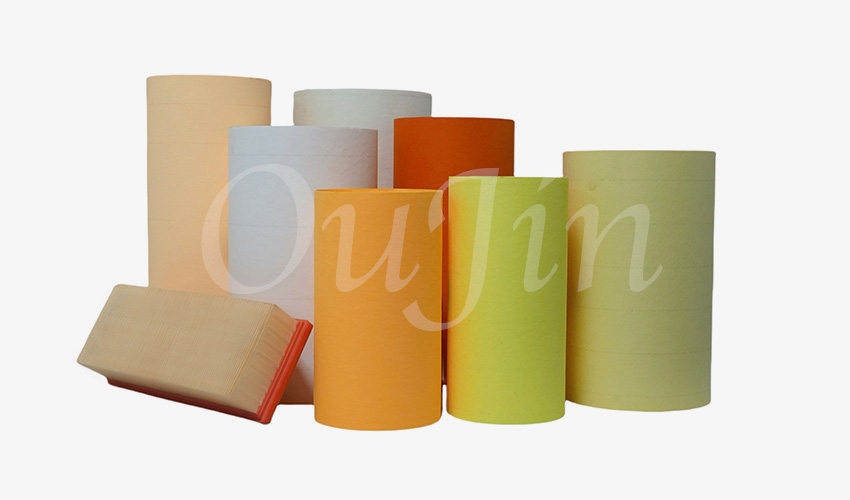
The table below summarizes typical characteristics to help choose the right media for a given application.
| Filtration Media | Typical Application | Typical Capture Range (µm) | Typical Max Temp (°C) | Strengths |
|---|---|---|---|---|
| Air Filter Paper | Engine intake pleated filters | 1 – 10 | ~150 | Best balance: airflow vs. fine particle capture |
| automotive filter paper | General purpose automotive filters | 1 – 20 | 120–150 | Versatile; used across multiple filter types |
| oil filter paper | Lubrication systems (spin-on / cartridge) | 5 – 40 | 150–180 | Chemical resistance; structural stability in oil |
| fuel filter paper | Fuel lines, in-tank & inline filters | 3 – 30 | ~140 | Removes rust, varnish, water; protects injectors |
| other filter media | Cabin air, hydraulic, specialty | Varies | Varies | Tailored solutions: activated carbon, synthetics, blends |
Interpretation: For engine air intake, Air Filter Paper gives the best trade-off between efficiency and airflow. For oil and fuel systems, media optimized for fluid compatibility and mechanical stability are necessary.
Use the following checklist to decide which media and filter type fit your needs:
Define operating environment:
Urban streets with high particulate pollution → prioritize higher efficiency and dust-holding.
Off-road or construction sites → prioritize reinforced media and higher rigidity.
Define service interval goals:
Long intervals (fleet uptime) → choose media with higher dust-holding capacity and robust pleat support.
Engine type:
Turbocharged/direct-injection/high-performance → higher capture for fine particulates to protect injectors and turbo bearings.
Temperature exposure:
High ambient or under-hood temperatures → select media with high thermal stability.
Fluid compatibility for oil/fuel:
Choose oil filter media and fuel filter media that resist additives, water, and varnishing agents.
Below are illustrative (not guaranteed) impacts based on typical industry observations when upgrading from standard paper media to a high-efficiency Air Filter Paper solution in similar pleated filter designs:
Fuel economy improvement: 3% – 8% (depends on engine and driving cycle)
Increased dust-holding capacity: 25% – 60%
Service interval extension: 20% – 50%
Reduction in engine wear markers (soot, insolubles in oil): measurable decrease over oil analysis cycles
These figures vary by engine, load, driving style, and environment; they are provided as directional guidance to compare benefits.
A practical fleet manager or technician should understand the chained effects:
If intake filtration is poor, more particulates reach combustion, producing more soot and acids in oil → this shortens the life of oil filter media and the oil itself.
Contaminated fuel (poor fuel filter media) leads to injector wear, poor spray patterns, and incomplete combustion → affects emissions and fuel economy.
Oil filter media that cannot handle high contamination loads or collapse under pressure spikes may allow debris to recirculate, increasing wear.
Thus, investing in premium Air Filter Paper and appropriate oil filter paper and fuel filter paper is a systems-level decision that yields multiplicative benefits.
Nanofiber integration: nanofiber layers over base Air Filter Paper improve ultrafine capture while preserving airflow.
Eco-conscious binders: water-based resins and biodegradable fiber blends are appearing to reduce lifecycle environmental impact.
Composite pleat supports: to prevent collapse at long intervals and under harsh vibration.
Advanced testing & digital QC: laser-based pore structure inspection ensures consistent element-to-element performance.
Baseline vehicle — city driving, dusty environment: stock filter with conventional media.
Upgrade scenario — replace with a pleated filter using advanced Air Filter Paper (multi-layer with nanofiber surface).
Observed (after controlled interval):
Measurable improvement in mass airflow stability.
Slight improvement in average mpg on mixed cycle (2%–6%).
Lower particulate and insolubles in oil analysis after 10k km.
This case highlights how media selection influences real maintenance metrics.
Always ensure correct sealing and gasket condition when replacing filters; bypass around the filter nullifies media quality.
Avoid oiling dry synthetic air filters unless recommended by the filter maker — oil can trap fine particulates, increase pressure drop, and cause sensor errors.
Inspect pleats for damage and ensure pleat spacing is correct; collapsed pleats reduce effective media area and increase pressure drop.
When selecting suppliers, look for:
Technical data sheets that list particle capture efficiency, basis weight, air permeability, and collapse resistance.
Third-party test reports (ISO/SAE standards where applicable).
Traceability and batch-level QC.
Hebei Oujin Nonwoven Technology Co., Ltd is a supplier that provides engineered Air Filter Paper products for automotive applications and publishes technical specifications for product selection. Their Air Filter Paper lineup covers common automotive applications and specialty needs.
Air Filter Paper is manufactured with controlled fiber size distribution, porosity gradients, and resin/binder treatments specifically designed for pleated engine air filters. Generic paper lacks these engineering controls and will either block too fast or allow damaging particulates through.
Service intervals depend on environment and driving patterns. In clean suburban use, premium media can extend intervals by 20%–50% compared to basic paper. In dusty or off-road conditions, inspect more frequently. Use pressure-differential or visual inspection rules where available.
If designed properly, high-efficiency filters optimize airflow while capturing more particles. A poorly designed filter (too dense, high pressure drop) can hurt performance, which is why media specification matters.
Yes. Oil filter media must resist oil chemistry, maintain strength in wet conditions, and handle pressure spikes. Air filter media focuses on airflow and dry particulate capture. Both must be chosen to match application demands.
Check the supplier’s technical data (particle capture efficiency, pressure drop curves, dust-holding capacity), third-party testing certificates, and historical field performance data.
High-efficiency automotive filters deliver clear system-level advantages: better fuel economy, lower engine wear, more stable sensor and emissions performance, and often reduced maintenance costs. Air Filter Paper is a central enabler of those benefits — its engineered structure and treatments determine how effectively a filter balances airflow and particle capture. When you select filters, consider not only the media type (air, oil, fuel) but the whole filtration strategy for the vehicle. For fleets and performance-focused owners alike, the right media choice is an investment that pays back through longer component life, fewer unscheduled repairs, and improved operational efficiency.


