

Views: 0 Author: Site Editor Publish Time: 2025-12-17 Origin: Site
Understanding the differences between air intake, lubrication, and fuel system filter media is essential for engineers, vehicle owners, fleet operators, and aftermarket manufacturers. Among all automotive filter materials, Air Filter Paper plays an especially crucial role in ensuring clean combustion and engine health. However, many users are unsure how Air Filter Paper compares with oil filter paper, fuel filter paper, and other filter media found throughout a vehicle.
This complete guide provides an in-depth comparison of the three major filtration papers—Air Filter Paper, oil filter paper, and fuel filter paper—helping you evaluate their structure, performance, applications, and selection criteria. It also highlights current trends in automotive filtration and provides data-driven insights backed by real engineering requirements.
Today’s engines—whether gasoline, diesel, hybrid, or turbocharged—require extremely clean air, oil, and fuel. With the rise of advanced engine technologies such as direct injection and high-compression engines, filtration standards have increased sharply.
Each filtration system uses the correct medium for its specific conditions:
Air intake → Air Filter Paper
Lubrication → oil filter paper
Fuel delivery → fuel filter paper
HVAC, hydraulic, and specialty systems → other filter media
Choosing the right media affects:
Engine longevity
Fuel efficiency
Combustion stability
Maintenance costs
Emissions performance
This is why Air Filter Paper has become a key performance driver in modern air intake systems, and why comparing it with other filter papers is essential.
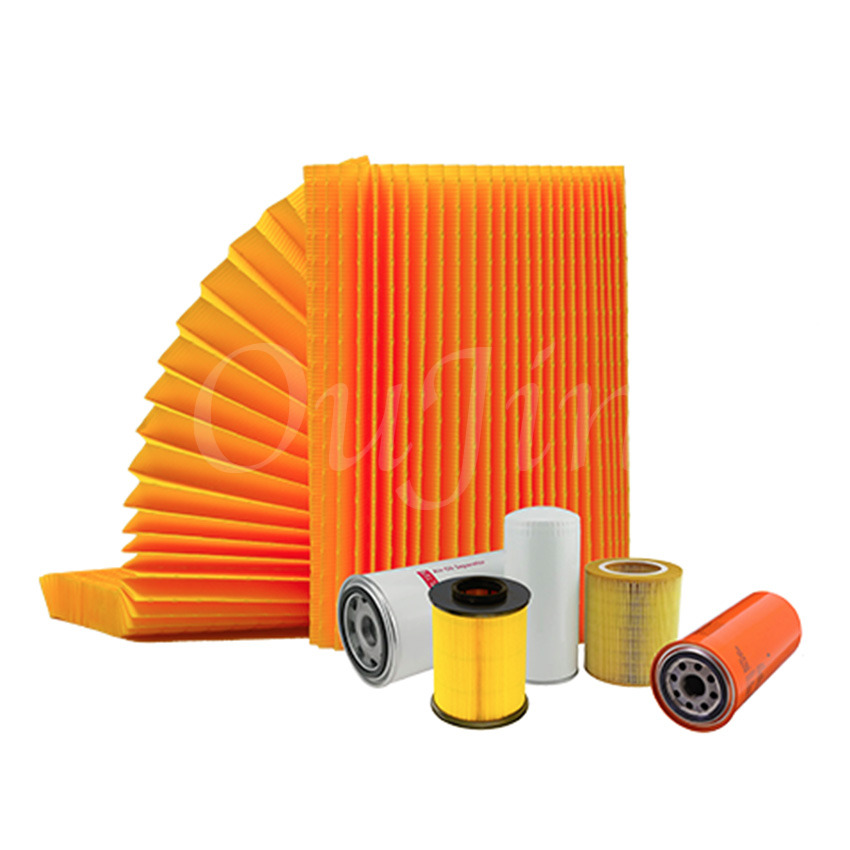
Air Filter Paper is an engineered porous filtration material used primarily in air intake filters. Its design ensures a balance of:
High airflow
Consistent micron-level filtration
Dust-holding ability
Resistance to deformation
Stable performance in varying humidity and temperature
Many Air Filter Paper types, including those provided by Hebei Oujin Nonwoven Technology Co., Ltd, use gradient-density structures, resin impregnation, and uniform fiber distribution to ensure high efficiency and stability.
Oil filter paper is designed to withstand hot, chemically active engine oil. It must maintain structural integrity despite exposure to:
High temperatures
Shearing forces
Oil additives
Soot and sludge contaminants
High flow pressure
Typical characteristics of oil filter paper include:
Tight pore structure to capture soot
Strong wet strength
High burst resistance
Chemical resistance to detergents and additives
Unlike Air Filter Paper, oil filter paper must function effectively even when fully saturated with oil.
Fuel filter paper protects modern high-pressure fuel injection systems from water, varnish, rust particles, and other fine contaminants. Since injectors operate with micron-level tolerances, fuel filtration has become increasingly critical.
Key characteristics of fuel filter paper include:
Ability to separate water from fuel
Micron-level particulate filtration (3–30 microns)
Stable pore structure
Compatibility with gasoline or diesel
Resistance to swelling or collapsing
Its function differs significantly from Air Filter Paper because it must operate in a liquid environment with stricter micron requirements.
Below is a detailed comparison table illustrating key performance differences:
| Feature | Air Filter Paper | oil filter paper | fuel filter paper |
|---|---|---|---|
| Operating Medium | Air | Engine oil | Fuel |
| Typical Micron Rating | 1–10 µm | 5–40 µm | 3–30 µm |
| Temperature Resistance | Up to ~150°C | Up to 180°C | Up to 140°C |
| Main Purpose | Protect engine from airborne contaminants | Remove soot & impurities from oil | Protect injectors from water & particles |
| Structure | Porous, resin-impregnated | Wet-strength reinforced | Chemical- and fuel-resistant |
| Dust-Holding Capacity | High | Medium | Medium |
| Flow Resistance | Very low | Medium | Medium–high |
| Compatibility Needs | Air only | Hot oil & additives | Fuel, water, rust |
Although each filtration material is essential, Air Filter Paper directly influences combustion quality. Poor intake air filtration is responsible for:
Increased soot production
Higher fuel consumption
Cylinder wear
Turbocharger damage
Faster oil contamination
This means that Air Filter Paper quality indirectly affects the workload of oil filter paper and fuel filter paper.
More dust entering combustion → more soot → greater load on oil filter paper
Incomplete combustion → deposits → clogged injectors → more pressure on fuel filter paper
Airborne contaminants reaching sensors (MAF) → unstable fueling → fuel system stress
Because combustion begins with air, Air Filter Paper impacts every downstream process.
Common engineering features found in Air Filter Paper include:
Air Filter Paper often uses a multi-layer or gradient design:
Outer layer → captures large particles
Middle layer → captures fine particles
Inner layer → stabilizes airflow
Resin-treated Air Filter Paper offers:
Higher rigidity for pleating
Moisture resistance
Higher burst strength
Uniform fiber patterns ensure:
Consistent airflow
Predictable micron performance
Even dust distribution
These characteristics differ significantly from oil filter paper, which requires wet strength, and fuel filter paper, which needs chemical stability.
Modern vehicles use other filter media besides the three major ones. These include:
Synthetic fiber media
Melt-blown nonwoven media
Activated carbon layers
HEPA cabin air filter media
While these other filter media are essential, Air Filter Paper remains the foundational medium for intake filtration due to its cost-efficiency, performance balance, and durability.
Hybrid engines rely heavily on precise airflow and filtration to minimize emissions during engine start-stop cycles.
Filtration materials are becoming finer and more efficient.
Applied to Air Filter Paper to capture sub-micron particles without sacrificing airflow.
Manufacturers are reducing VOCs during resin impregnation and using sustainable fibers in other filter media.
Fleet operators demand filter media that last longer with stable performance.
Air Filter Paper, oil filter paper, and fuel filter paper are all evolving with these global trends, but Air Filter Paper sees the most innovation because air intake filtration is critical for emissions control.
You need maximum airflow
You need high dust-holding capacity
The environment is dusty or harsh
Engine breathing quality is a priority
The medium must remain stable in oil
Operating temperatures exceed 150°C
You need structural strength under pressure
Protecting injectors from water and particles
Operating under high fuel pressures
Maintaining consistency under fluid contact
Special cabin air filtration is needed
Hydraulic systems require unique media
Activated carbon is required for odor absorption
| Property | Air Filter Paper | oil filter paper | fuel filter paper | other filter media |
|---|---|---|---|---|
| Environment | Air | Oil | Fuel | Varies |
| Filtration Goal | Dust protection | Soot removal | Injector protection | Specialty |
| Media Composition | Cellulose/synthetic blend | Resin-reinforced cellulose | Fuel-resistant cellulose | Synthetic / carbon |
| Pressure Exposure | Low | High | Medium–high | Varies |
| Expected Lifespan | Medium–High | Medium | Medium | Varies |
| Maintenance Cost | Low | Medium | Medium | Varies |
What is the primary difference between Air Filter Paper and oil filter paper?
Air Filter Paper is optimized for airflow and fine particulate capture. oil filter paper is optimized for wet strength and heat resistance.
Which filter paper protects the fuel injectors?
That function belongs to fuel filter paper, which removes water, varnish, and rust particles.
Why does Air Filter Paper affect fuel efficiency?
Clean air improves combustion efficiency. Restrictive or poor-quality air filtration increases fuel consumption.
Can Air Filter Paper be used in fuel systems?
No. Fuel systems require fuel filter paper, which is designed for chemical compatibility and water separation.
Where can I find high-quality Air Filter Paper?
You can find professional-grade, high-performance Air Filter Paper from Hebei Oujin Nonwoven Technology Co., Ltd here: Air Filter Paper


